
Havyaka
IST

Havyaka

  It is beyond a doubt that each human group is biologically distinct and culturally unique, and we Havyakas are no exception to this rule. But our uniqueness lies in our historical and cultural distinctiveness from the other Brahmin sects of Karnataka.

  Havyaka Brahmins (also referred to as Haveeka, Havika, Haiga and Haveega) are the Hindu Pancha Dravida Vedic Brahmins from the Indian state of Karnataka. Havyakas profess the Advaita philosophy propounded by Adi Shankaracharya. Most Havyakas can trace their immediate ancestry to either Dakshina Kannada, Uttara Kannada or Shimoga districts of Karnataka and Kasaragod district of Kerala.

Etymology

 The word Havyaka was transcended from words Havyaga or Haveega which means the one who performs Havana and Homa. These are known as “Havya” and the person who performs them is known as “Havyaka.” The traditional vocation of Havyaka Brahmins was to perform the rituals of Homa-Havana and therefore they came to be known by the name of their profession.

 Other theory have been proposed as well. The name “Haiga” persists in Havyaka lexicon. The word Havyaka might also be derived from the place named Haigunda. It is said that the first few families were settled in Haigunda. Haigunda is a village located in an island in Sharavathi river, Honnavara taluk, Karnataka.

Origin of Havyakas

 According to the research, Havyaka’s immigration back to about 1700 years ago i.e.around 4th century, during the reign of King Mayuravarma (345–365)CE.

 An inscription found at Talagunda indicates that 32 Brahmins were relocated from a place called Ahichchhatrato Sthanagundur (Ahichchhatra) by Mukanna (or Trinetra), thereby creating an agrahara. Mukanna was an ancestor of Mayuravarma, the founder of the Kadamba Dynasty. The extensive remains of Ahichhatra, the Capital town of Northern Panchala have been discovered near Ramnagar village of Aonla Tehsil in the district of Bareilly in the state of Uttara Pradesh.

 King Mayuravarma’s act of inviting Havyakas to Banavasi has also been inscribed on a stone slab (Shilashasana) from the period of the Kadambas, which now lies near the village of Varadahalli (Varadapura) in Sagar Taluk of Shimoga district.

Havyaka Today

 Havyakas profess the Advaita philosophy propounded by Adi Shankaracharya.

 Most Havyakas are Yajurvedi Brahmins and follow the Baudhayana Shrauta Sutra (Taittirya Krishna Yujurveda). Some are Samavedi’s and few Havyakas follow Rigveda which is the oldest in Vedas.

 Havyakas derive their last names from the jobs that they perform rather than by their origin. Thus came the names “Hegade (Hegde)” for the head of the village who sponsors the ritualistic activities, “Dixit” for one who is the head of the Yajna, “Bhat”, who actually performs the rituals and so on.

 Till recently Havyakas were primarily engaged in vedic professions like priests or they were in agriculture especially growing betel nut, paddy, banana, coconut etc. A few decades back they also started entering into all other vocations like business, education, employment etc.

 Population of Havyakas all around the world is estimated to be about 11,00,000.

Geographic Distribution

 Havyakas are mainly concentrated in the state of Karnataka. Dakshina Kannada, Uttar Kannada, Shimoga, Chikmagalur, Kodagu, Manglore Districts in Karnataka and Kasarogod in Kerala are the districts where Havyakas live for centuries. They are now spread all over India, especially in metropolitan cities of Mumbai, New Delhi, Bengaluru and other Industrial and business centres. Havyakas are also in large numbers in countries like United States of America, United Kingdom and other places outside India.

Surnames

 Havyakas derive their last names from the jobs that they perform rather than by their origin. Names include Bhat, Hegde, Bhagwat, Joshi, Joisa, Bhadti, Hosmane, Vaidya, Hiregange; Avadhani, , Kamte, Dixit, Gaonkar, Joisa, Karnik, Murthy, Markande, Pandit, Puranik, Rao, Raysad, Sabhahit, Sharma, Vathi, Shastri, Shanbhag, Shastry, Upadhyaya, Upadhya, Adkoli, Baravani, Hebbar, Gayatri, Dhooli, Gadde, Yaji, Pratahkal, Ugru Bhatta, Bailkeri, Shankarlinga, Kalmane etc.

Language

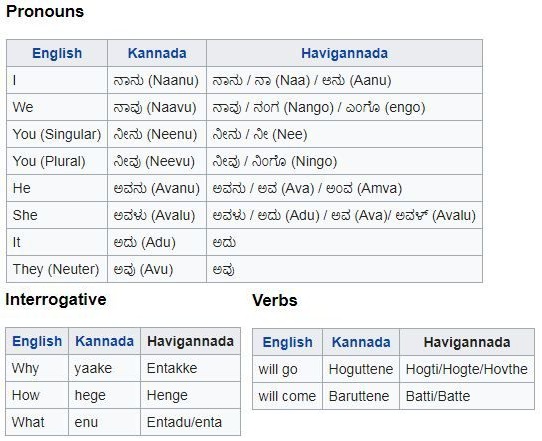
 The Havyakas are united by their unique language. They speak a dialect of Kannada known as Havigannada or Havyaka Kannada. It is similar to mainstream Kannada but draws more words from ancient Kannada. However, most mainstream Kannada speakers find it difficult to understand Havyaka Kannada.

 It is spoken in the taluks of Mangalore, Sringeri, Mudigere, Udupi, Thirthahalli, Karkala, Sagara, Sirsi, Yellapur, Siddapur, Honnavar, Kumta, Puttur, Gokarna, Hosanagara, etc. where there is a higher density of Havyakas in relation to other places.

 In some parts of Uttara Kannada District like Kumta, Honnavara, Sirsi and Siddapur, often Neuter gender is used instead of Feminine gender.

 Havyaka has two sub-dialects, namely, Northern Havyaka and Southern Havyaka. Northern and Southern dialects usually referred to the speech of the Havyaka people residing in North Canara and South Canara respectively.

 Havigannada was partly used in Sandalwood films: Bettada Jeeva, Nammoora Mandara Hoove and Naayi Neralu which was shot in and around Yana.

 There also a dictionary, Havyaka-English dictionary (1983) by Prof. M. Mariappa Bhat.

Art, literature and culture

 As Havyakas gained population in Karnataka they became influential in politics and also cultivated fine arts. The Yakshagana folk theatre has been exclusively developed by Havyakas. Music, dance and writing became very attractive to Havyakas. Karki Yakshagana group which toured Maharashtra in the mid-19th century has the credit of inspiring Marathi theatre. In 1842, Karki Mela (group) performed before the Rajasaheb of Sangli (Maharashtra State), who encouraged court artists to learn from the group acting and singing. This laid basis for Marathi Professional theatre.

 The first social play in Kannada was written by Suri Venkataramana Shastri in 1887. The play titled Iggappa Hegade Vivaha Prahasana deals with child marriage and evils of incompatibility. There have been a good number of writers, singers, teachers, doctors, industrialists, scientists, engineers and executives from Havyaka community.

 A good number of youngsters have taken up Hindustani classical music and Karnataka classical music.

Havyaka Food

 Havyakas are traditionally lacto-vegetarian in their diet, and their cuisine consists of some unique food items including Tellavu (a light type of dosa), Todedev (a wafer-thin sweet preparation), Melara, Balehannu Shavige (A vermicelli preparation using banana), Odappe, Holige, Appehuli, Gensle (sweet which is baked in masala leaf), Halasinakayi huli (very popular in Kalache-Yellapur region of Uttarakannada district), various types of Thambli (buttermilk/yoghurt-based rice accompaniment) including Korskayi Tambli, various types of Gojju (gravy) including Kocheegayi Gojju,Korskayi Gojju,Kai Gojju,Kadle Gojju (famous in Sagar prantya), etc. Other commonly-prepared items include Hagalkai Hashi (a type of salad made from bitter gourd), Kai Rasaa, Karkli, patrode, famous Soppina Tambli-Swarle-kudi, various leaf-based preparations such as Honegone Soppu, Vidangada Soppu, Vasange Soppu, Yelgurge kudi/soppu, Sorle kudi/soppu, Kanchi-soppu and Choand Gte-soppu, Kajale-palya, Huli, Sasame made of mango and Kannekudi katne. Many items are prepared using jack-fruit such as sweet pappads, several types of Thamblis and a variety of Chatni pudis, Sandige and Happala which can be preserved for a long time.

 They are also known for their preparations of banana Halwa, Berati of jack-fruit and Halasina Hannina Kadubu. Havyakas have a unique food system which has intrinsic medicinal values. Some of the ingredients used in food items include wild leaves, roots/herbs and barks of trees, among others. Havyakas typically lived in villages where abundant sources of these were readily available around them, from where they were directly extracted and processed fresh.

Havyaka Gotra

 The Havyakas Brahmins follow the gotra system.

• Bharadwaja

• Vashistha

• Angeerasa

• Gautama

• Jamadagni
• Kashyapa
• Vishwamitra

Glossary

Ahichchhatra

Ahichchhatra (or Ahi-Kshetra) was the ancient capital of Northern Panchala. The remains of this city has been discovered in Bareilly.

 The word Ahi means snake or Naga in Sanskrit. Nagas were a group of ancient people who worshiped serpents. The word khsetra means region in Sanskrit. This implies that Ahi-kshetra was a region of Nagas. This could mean that the region was populated originally by Nagas, Nairs, Bunts of Kerala and Tulu Nadu who claim Kshatriya descent from the nagas as well as Namputhiri of Kerala, Havyaka Brahmins of North Canara and Tuluva Brahmins of Mangalore and Udupi, Hindu philosophers Adi Shankara and Madhvacharya belonging to these communities) trace their origins to this place.

 The territory under Ahichchhatra was formerly under the Panchala king Drupada. Later it was taken over by Drona, after a war, in which Drupada was defeated by Drona’s disciple Arjuna. Ashwatthama, the son of Drona, was given the responsibility of ruling the territory of Northern Panchala from Ahichchhatra. Ashwatthama probably ruled the kingdom being subordinate to the rulers of Hastinapura.

Talagunda

 Talagunda is a village in the Shikaripura taluk of Shimoga district in the state of Karnataka, India. Many inscriptions found here have provided insights into the rise of the Kadamba Dynasty.

 Talagunda was earlier known as Sthanagundur and it was an agrahara (a place of learning). This is the earliest known agrahara found in Karnataka.

Talagunda Inscriptions

The famous Talagunda pillar inscription (450-460 A.D) that details the rise of the Kadamba Dynasty.

 A temple dedicated to Pranaveshwara (Hindu God Shiva) is located in Talagunda. Next to it is located a stone slab containing inscriptions. In front of it is a pillar containing inscriptions in Sanskrit. The pillar inscriptions were written in the mid 5th century CE during the reign of Śāntivarman (a descendant of Mayurasharma). The author of this inscription was Kubja, the court-poet of Śāntivarman,

 The inscriptions indicate that Mayurasharma, native of Talagunda, was accomplished in vaidika and went to the Pallava capital, Kanchipuram to study scriptures, accompanied by his guru and grandfather Veerasharama. There, having been humiliated by a Pallava guard (horseman), in a rage Mayurasharma gave up his Brahminic studies and took to the sword to avenge his insult. From Brahmin Mayursharma, he became Kshatriya Mayuravarma, the founder of Great Kadamba empire.

REFERENCES

https://en.wikipedia.org/wiki/Havigannada_dialect
https://www.outsourcingtranslation.com/resources/history/kannada-language.php
https://tulu-research.blogspot.com/2016/10/366-mystery-of-gokarna-and-havyaka.html
https://en.wikiquote.org/wiki/Kannada_language
https://en.wikipedia.org/wiki/Kadamba_dynasty
https://en.wikipedia.org/wiki/Havyaka_Brahmin
https://en.wikipedia.org/wiki/Mayurasharma
http://www.hamarerishte.com/community/family/havyaka-community?cmid=42
https://www.niu.edu/hosmane/aboutme/roots.shtml
http://www.languageinindia.com/sep2005/kannadadictionary1.html
https://en.wikipedia.org/wiki/Talagunda
http://vedicheritage.gov.in/brahmanas/taittiriya-brhamana/…

Translate »